Plywood as a circular material in everyday spaces part 1
Have you ever noticed that recycling bins are the pieces of furniture we touch and
use most often during the day? We open them, close them, move them, and clean
them. Yet we often treat them as mere disposable “containers” that should be
replaced someday and rarely question the materials they are made of.
At Niimaar, we see recycling solutions differently. For us, recycling stations are an
integral part of the interior: furniture that should last for years and be aesthetically
pleasing. That’s why material choice is so important. It determines not only the
product’s durability, but also how it ages, whether it can be repaired, and what
happens to it at the end of its life cycle.
According to insights from the Ellen MacArthur Foundation, up to 70% of a product’s
environmental footprint, its future ability to be reused or recycled, as well as its life-
cycle costs, are determined by the materials used at the design phase. At Niimaar,
we are driven by circular design principles, working to eliminate waste and keep
products and materials in use for longer. For us, sustainability begins with material
choice.
At the core of our products is birch plywood that comes from Koskisen, a Finnish
local company that provides full transparency of the wood’s journey from the forest to
a finely engineered sheet. This means that material sourcing, logistics, and
processing are handled responsibly at every production step. Koskisen plywood is
widely used in the most demanding applications—from the construction of aircraft
components and bowling lanes to packaging, furniture, and interior design.
So what makes plywood such a sustainable and beneficial choice compared to
other alternatives?
So what makes plywood such a sustainable and beneficial choice compared to
other alternatives?
Longevity & durability
High-quality birch plywood is built to last. Due to multiple layers of veneer pressed together, the material can maintain its strength and shape over 15–25 years. This cross-laminated structure gives the material exceptional stiffness and impact resistance, meaning that it does not warp or crack under point loads, even with heavy or repeated use.
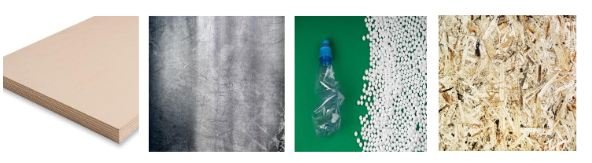
When compared to plastic, metal, or MDF (medium-density fiberboard), which are commonly used for recycling stations, we see significant shortcomings. Though plastic can be cheap and quite durable at first, under constant stress, it deforms over time (causing its “creeping”). Additionally, temperature extremes and UV exposure affect the polymer bonds, making plastic brittle, decoloured, and prone to cracking. Metal, on the other hand, is strong but vulnerable to corrosion, dents, and scratches. Similarly, MDF can crack under extreme stress and absorbs moisture more quickly, leading to sagging and swelling.
For Niimaar, material quality defines the longevity of our products. The birch plywood we source from Koskisen has proven stiffness, excellent strength, and resistance to creep. Its coating also provides outstanding moisture resistance. That’s why we ensure the durability of our products and give a guarantee to our clients for one year. And it’s not just the bins themselves—our multi-use recycling bags are also designed to last long: they are water-resistant and can be easily washed.
To be continued
Share Story